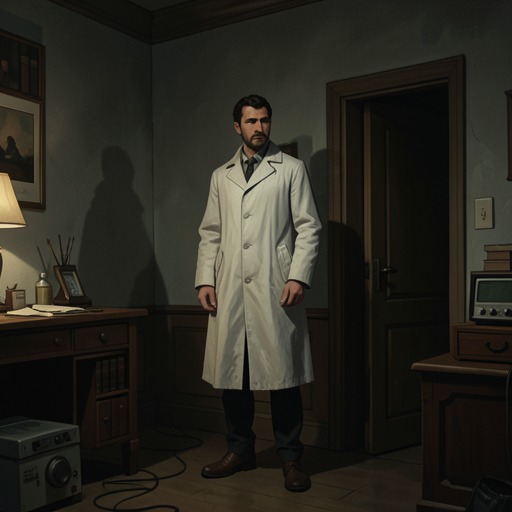
Johanson's secret hatch discovery and memory erasure
The SwarmSigur Johanson’s discovery of a concealed opening aboard the Independence becomes the prelude to a deliberate attempt to erase his memory. What begins as a solitary encounter with a door in the hangar ends in a controlled account of his whereabouts, a blank in his recollection, and a private discussion in which Judith Li, Jack Vanderbilt, and Sal Peak weigh how thoroughly they can keep the episode from returning to his mind.
The opening in the hangar
After sitting down on the crate that had served as a makeshift bar, Johanson drinks Bordeaux and dozes. A soft metallic noise wakes him. For a moment he is disoriented; then he feels the pain in his back against the steel side of the hangar and sees the sky brightening over the sea. The bulkhead has parted. Where there had been an unbroken metal surface, a door now stands open, revealing a space of about three square metres lit against the dark metal.
The empty bottle offers one possible explanation for what he is seeing, and Johanson briefly wonders whether he is dreaming. But the opening leads into a real corridor: plain walls, harsh neon light, and a passage that runs a few metres before turning out of sight. From the doorway he hears voices and other sounds. He recognizes that he is aboard a warship and that the rooms beyond may have a purpose that has nothing to do with a civilian scientist. His hesitation is practical, not a failure to notice the risk.
What turns him around is the thought of Rubin. Johanson knows that if he backs away, he will keep wondering what lies beyond the door. He steps inside. The decision crosses a boundary whose significance he cannot yet assess: the passage is not merely a strange interruption in the hangar’s familiar surfaces, but an entrance into a space someone has reason to keep inaccessible.
A controlled space
The later account of Rubin’s route into a large, dark control room gives the concealed access a wider institutional context. On level 03, Rubin reaches a narrow locked door and enters a corridor using a code. At a second locked door, a green light and a camera behind glass mark an additional layer of security. He places his right eye before the camera; only after the retinal scan gives clearance does the door slide open.
Inside, the room resembles the CIC and is occupied by civilians and uniformed personnel at computer-filled control desks. Li, Vanderbilt, and Peak stand around a chart table illuminated from below. The contrast with Johanson’s first impression is telling: from the hangar he had seen a sliver of light and heard indistinct voices; Rubin’s authorized entry reveals an organized, staffed operation behind those sounds. The evidence does not establish precisely how Johanson’s doorway connects to every part of the control room, but it places his unexplained discovery beside a space protected by codes, biometric identification, and a camera.
Rubin’s access also exposes the secrecy surrounding the operation. He resents being kept under the CIA’s veil of confidentiality and imagines that, once the crisis is over, he will publicize his achievements and receive recognition for helping save humanity. His confidence sits alongside the room’s elaborate access controls: he can enter, but the knowledge and the project remain subject to other people’s authority.
The missing interval
Johanson later tells Sid Angeli that he has no idea what happened. Angeli says Johanson was found in the middle of the night on the hangar deck and suggests that he may have slipped or struck his head on one of the struts. The ship’s video surveillance, Angeli explains, is why he was found; without it, he might still have been lying there. Angeli also mentions the empty bottle and says Sue Oliviera had told him that she and Johanson had opened wine together. He cautions that a helicopter carrier is dangerous when wet and dark, especially for someone who has been drinking.
Johanson’s recollection is more complicated than Angeli’s explanation. He remembers being on the hangar deck with Sue Oliviera, and then being there a second time alone. He can remember going back, but not why; what happened next is absent. Angeli’s proposed fall may account for his condition, but it cannot fill the gap in his memory. The surveillance establishes that the ship recorded his presence, not that Johanson himself can reconstruct the events.
This gap makes the earlier choice to enter the passage newly consequential. The discovery is not followed by a clear memory of what Johanson saw or did. Instead, the reader encounters the result as an uneven sequence: a door opening, Johanson going inside, and later a return to the hangar that he can remember only in outline. His uncertainty is not simply an unanswered question about a corridor. It is the condition that allows others to discuss his mind as something to manage.
The attempt to erase memory
In the control room, Li asks whether the drug worked. Peak says that they injected ten mills: more, he explains, would have incapacitated Johanson too severely, and they need his brain. The drug is intended to act like an eraser on the mind, but Peak makes clear that its success is uncertain. Vanderbilt agrees that no drug can suppress a memory entirely and that too little is known about how the brain works. Li orders that Johanson remain under observation and asks Rubin how much longer they will need him.
The exchange establishes that the loss of memory is not treated by Li’s group as an accidental consequence of drinking or a fall. They have administered a drug for the specific purpose of suppressing what Johanson might remember, while preserving his usefulness to them. Their discussion is calculated, but its terms reveal the limit of their control: the dose must not knock him out too far, and the erasure may fail. Johanson’s mind is both an instrument they need and a source of danger they cannot fully govern.
Peak identifies the risk in concrete terms: a word, a colour, or a smell could trigger the return of an entire memory. Li’s plan is therefore not a confident closure but an attempt to hold a fragile boundary in place through observation. The opening in the bulkhead and the blank in Johanson’s recollection mirror each other: one makes a hidden interior visible, while the other is intended to conceal what he has encountered. The episode’s suspense rests on the difference between hiding an event and ensuring that it can never be remembered.